

1100 aluminum coil belongs to the 1xxx series high-purity aluminum alloy (aluminum content ≥99.0%) and is renowned for its excellent ductility, good corrosion resistance, and outstanding processing performance. It is especially suitable for applications that require deep drawing, bending, or complex forming, but do not demand high material strength.
Since 1100 aluminum cannot be strengthened through heat treatment, its performance mainly relies on cold working and the inherent properties of the material itself. Through anodizing treatment, not only can its corrosion resistance be further enhanced, but a more aesthetically pleasing surface finish can also be achieved, adding decorative value to the product.
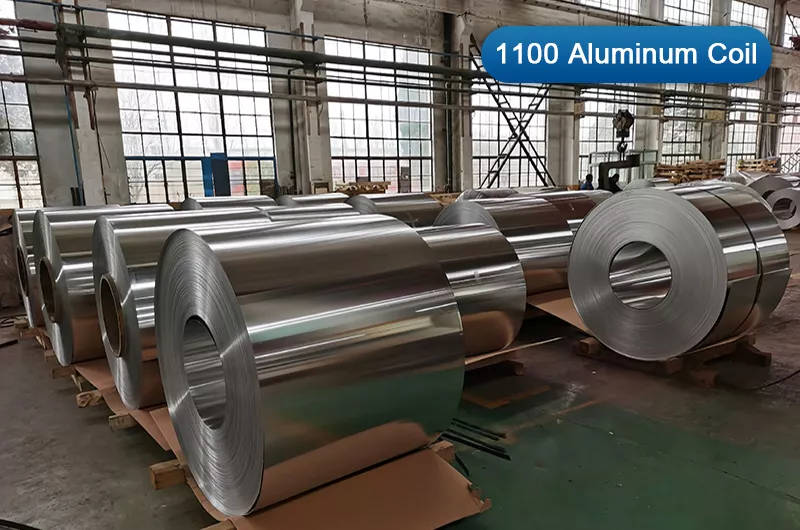
With its softness and ease of processing, 1100 aluminum coil is widely used in the aluminum alloy market, especially in the O temper (soft state). Whether it is decorative items, electronic product enclosures, or food and beverage containers, 1100 aluminum coil can perform reliably. Its high versatility and processing flexibility make it the preferred material in fields that demand high corrosion resistance and formability while requiring relatively low strength.
1100 Aluminum Coil Specifications
| Aluminum alloy | 1100 Aluminum coil |
| Temper | O, H14, H18, H22, H24, etc. |
| Thickness (mm) | 0.10-4.5 |
| Width (mm) | 400-2650 |
| Length (mm) | Customized according to requirements |
| Surface Treatment | Raw material surface, Brushed, Anodized, Film coated or Painted |
| Application examples | CTP and PS plates, aluminum composite panels, lighting, explosion relief valve for batteries, aluminum lugs, etc. |
Common Aluminum Coil 1100 Standards
1100 H14 Aluminum Coil
1100 H14 aluminum coil is a partially cold-worked strengthened aluminum material that maintains excellent ductility and corrosion resistance, suitable for applications requiring medium strength and good workability. It is commonly used in architectural decoration, air-conditioning ducts, chemical equipment, and lightweight structural components, capable of meeting bending, folding, and stamping requirements while maintaining stable dimensions and surface quality.
1100 O Aluminum Coil
1100 O aluminum coil is a fully annealed soft aluminum material with low strength but excellent plasticity and ductility. It is ideal for deep drawing, rolling, and other complex-shaped processing applications such as food packaging, decorative panels, and flexible tubing. Due to its pure material, smooth surface, and corrosion resistance, it is the perfect choice for applications that require high workability without additional strengthening.
1100 H18 Aluminum Coil
1100 H18 aluminum coil has been fully cold-worked to achieve higher strength while retaining some ductility. It is suitable for applications that bear significant mechanical loads, such as building curtain wall panels, transportation facilities, and machinery covers. Aluminum coil in this temper maintains stable dimensions and good surface quality, allowing it to withstand daily wear and environmental impacts while maintaining high strength.
Material Characteristics of 1100 Aluminum Alloy
Excellent Formability
1100 aluminum alloy belongs to the high-purity aluminum series. Although its intrinsic strength is not high, it demonstrates outstanding workability. In annealed or softened temper, its hardness is low, making it highly suitable for processes such as spinning, bending, stamping, rolling, and drawing. Whether for complex shapes or large deformation processes, 1100 aluminum can easily handle the task.
Hardness Enhancement via Cold Working
Although 1100 aluminum alloy cannot be strengthened by heat treatment, its hardness and strength can be improved through cold working processes. Even under low-temperature conditions, its mechanical performance is enhanced. We provide annealed aluminum coils, sheets, foils, and wires that meet industrial standards to satisfy different application requirements.
Outstanding Electrical and Thermal Conductivity
1100 aluminum alloy has excellent electrical and thermal conductivity, making it widely used in electronic equipment, particularly for manufacturing radiators, fins, and various heat exchange components. This feature not only improves device cooling efficiency but also ensures long-term stable operation.
Excellent Corrosion Resistance
1100 aluminum alloy also exhibits exceptional corrosion resistance, making it suitable for structures and components in harsh environments. Common applications include tank fittings for pipeline systems, railway vehicle components, ship structural materials, and even critical parts of aircraft gun mounts, ensuring that performance remains reliable over long-term use.
Aluminum Coil 1100 Mechanical Properties
| Temper | Specified Thickness(in) | Tensile Strength - KSI | Elongationin 2 inches % | |||
| Ultimate | Yield | |||||
| Min | Max | Min | Max | |||
| H12 | 0.017 - 0.019 | 14 | 19 | 11 | - | 3 |
| H12 | 0.020 - 0.031 | 14 | 19 | 11 | - | 4 |
| H12 | 0.032 - 0.050 | 14 | 19 | 11 | - | 6 |
| H12 | 0.051 - 0.113 | 14 | 19 | 11 | - | 8 |
| H12 | 0.114 - 0.250 | 14 | 19 | 11 | - | 9 |
| H14 | 0.009 - 0.012 | 16 | 21 | 14 | - | 1 |
| H14 | 0.013 - 0.019 | 16 | 21 | 14 | - | 2 |
| H14 | 0.020 - 0.031 | 16 | 21 | 14 | - | 3 |
| H14 | 0.032 - 0.050 | 16 | 21 | 14 | - | 4 |
| H14 | 0.051 - 0.113 | 16 | 21 | 14 | - | 5 |
| H14 | 0.114 - 0.250 | 16 | 21 | 14 | - | 6 |
| H16 | 0.006 - 0.019 | 19 | 24 | 17 | - | 1 |
| H16 | 0.020 - 0.031 | 19 | 24 | 17 | - | 2 |
| H16 | 0.032 - 0.050 | 19 | 24 | 17 | - | 3 |
| H16 | 0.051 - 0.162 | 19 | 24 | 17 | - | 4 |
| H18 | 0.006 - 0.019 | 22 | - | - | - | 1 |
| H18 | 0.020 - 0.031 | 22 | - | - | - | 2 |
| H18 | 0.032 - 0.050 | 22 | - | - | - | 3 |
| H18 | 0.051 - 0.128 | 22 | - | - | - | 4 |
| H19 | 0.006 - 0.063 | 24 | - | - | - | 1 |
| O | 0.006 - 0.019 | 11 | 15.5 | 3.5 | - | 15 |
| O | 0.020 - 0.031 | 11 | 15.5 | 3.5 | - | 20 |
| O | 0.032 - 0.050 | 11 | 15.5 | 3.5 | - | 25 |
| O | 0.051 - 0.249 | 11 | 15.5 | 3.5 | - | 30 |
Chemical Composition Of 1100 Aluminum Coil
| Element | Percentage By Weight |
| Aluminum (Al) | 99.0 – 99.95% |
| Iron (Fe) | 0 – 0.95% |
| Silicon (Si) | 0 – 0.95% |
| Copper (Cu) | 0.05 – 0.20% |
| Manganese (Mn) | 0 – 0.05% |
| Zinc (Zn) | 0 – 0.1% |
| Other | 0 – 0.15% |
Applications of 1100 Aluminum Coil
Architectural Decoration and Engineering
- Curtain wall panels, ceilings, decorative strips, flashing panels
- Aluminum Composite Panel (ACP) substrates
- Signage, signboards, reflective panels
- Cladding, roofing panels, wall panels
Home Appliances and Electronics
- Large refrigerator liners
- Lighting materials and components
- Heat sinks, air conditioner fins, condenser plates
- Transformer and capacitor housings
Industrial and Chemical
- Tanks, pipes, chemical equipment linings (suitable for non-strongly corrosive media)
- Heat exchanger and condenser components
- Welded assemblies, printing plates
Daily Necessities and Hardware Products
- Kitchen utensils, tableware, cookware
- Bottle caps (e.g., wine caps), gift packaging
- Umbrella frames
- Deep drawn parts, spun parts, nameplates, reflectors
Packaging Materials
- Food containers, pharmaceutical packaging
- Aluminum composite panel substrates
1100 Aluminum Coil for Curtain Wall Panel
This 1100 aluminum coil is specially designed for building curtain wall panels. The material has a smooth surface and good ductility, making it easy to stamp, bend, and cut. It meets the aesthetic, durability, and lightweight requirements of building facades while providing excellent corrosion resistance to ensure long-term use without deformation.
1100 Mirror-Finished Aluminum Coil for Signage
The mirror-finished 1100 aluminum coil is suitable for advertising signs and display boards. Its surface is smooth and reflective, presenting a clear mirror effect that enhances visual appeal. The material is flexible for processing and can be cut, bent, or stamped according to design requirements.
1100 Aluminum Coil for Roofing Panel
This 1100 aluminum coil is designed for roofing panel manufacturing, offering lightweight, corrosion resistance, and weatherproof performance. It can be easily shaped into various roof structures, ensuring roofs remain rust-free and deformation-resistant over long-term use. The smooth surface is easy to clean and suitable for all climatic conditions.
1100 Embossed Aluminum Coil for Refrigerator Liner
The embossed 1100 aluminum coil is primarily used for refrigerator liners. The surface patterns are attractive and anti-slip, while the material is corrosion-resistant, easy to clean, and highly formable. It can be processed into various liner shapes, ensuring structural stability and long service life of the refrigerator.
1100 Aluminum Coil for Heat Sink
This 1100 aluminum coil is used to manufacture heat sinks or cooling fins. It has excellent thermal conductivity, quickly transferring and dissipating heat, suitable for electronic and mechanical equipment cooling needs. It is also easy to process into complex cooling structures, ensuring stable operation under high-temperature conditions.
1100 Anodized Aluminum Coil for Electrical Enclosure
The anodized 1100 aluminum coil is commonly used for electrical equipment enclosures. Its surface is hard, wear-resistant, and corrosion-resistant, protecting equipment in various environments. It has good workability, allowing stamping, bending, and assembly to ensure a sturdy and reliable enclosure structure.
1100 Aluminum Coil for Heat Exchanger
This aluminum coil is mainly used for manufacturing heat exchangers. The material has excellent thermal conductivity and can be easily processed into fins, tubes, and other structures, improving heat exchange efficiency. It is lightweight and corrosion-resistant, suitable for long-term use in industrial, air conditioning, and refrigeration systems without performance degradation.
1100 Aluminum Coil for Industrial Sheet
Industrial 1100 aluminum coil is suitable for manufacturing various machinery parts and process sheets. The material is uniform and stable, with controllable thickness, easy to stamp, bend, and weld. It can be used to produce industrial components, structural parts, and process sheets, ensuring product quality and processing efficiency.
1100 Aluminum Coil for Cookware
This 1100 aluminum coil is used for cookware manufacturing, offering lightweight and fast, even heat conduction. It can be processed into pots, pans, baking trays, and other kitchen items, ensuring uniform heat distribution during cooking. The material is also easy to clean, corrosion-resistant, and safe for use.
1100 Aluminum Coil for Deep Drawn Parts
The 1100 aluminum coil for deep drawn parts has excellent ductility, easy for stamping, stretching, and forming. It can produce complex-shaped containers, lamps, or tableware, with smooth surface and uniform thickness, ensuring product quality and refined appearance.
Prepainted 1100 Aluminum Coil for Packaging Material
The prepainted 1100 aluminum coil has a uniform surface color with strong adhesion, suitable for direct use in food, pharmaceutical, and daily goods packaging. It is both attractive and durable, easy to print and process, while protecting the contents from external environmental factors and extending shelf life.
1100 Aluminum Coil for Food Packaging
This 1100 aluminum coil meets food safety standards. It is corrosion-resistant, deformation-resistant, and suitable for making food trays, aluminum foils, and various packaging containers, ensuring food remains fresh and hygienic during transportation and storage. The material is also lightweight and easy to process.
1100 Aluminum Coil for Composite Panel Substrate
The 1100 aluminum coil for composite panel substrates has a smooth surface and uniform thickness, facilitating composite processing with other materials. It is commonly used in building curtain walls, advertising boards, and decorative panels, ensuring overall stability and aesthetic appeal. It also has good workability, allowing cutting, bending, and stamping.
Suitable Scenarios and Selection Recommendations
1100 aluminum coil is best suited for applications that do not require high strength but demand good formability, corrosion resistance, and electrical conductivity.
- For higher strength requirements, alloys such as 3003 or 5052 can be selected.
- For better corrosion resistance (e.g., marine environments), 5000 series alloys are recommended.
More Information About 1100 Aluminum Coil
Advantages and Disadvantages
1100 aluminum coil is based on high-purity aluminum, typically containing more than 99% aluminum, which gives it excellent corrosion resistance and good electrical and thermal conductivity. It is soft and highly formable, making it ideal for bending, stretching, stamping, and other processes. However, its strength is relatively low, making it unsuitable for high-load structural applications. For applications requiring lightweight and excellent corrosion resistance, 1100 aluminum coil is an ideal choice, but for industrial applications with high structural strength requirements, other alloys may need to be considered.
Machining
1100 aluminum coil is easy to machine and suitable for various processing methods such as cold bending, rolling, stamping, stretching, and spinning. Its low hardness and good plasticity reduce the risk of cracking during processing, while cold working can slightly increase strength (hardening). During machining, it is important to avoid high-temperature heating, as overheating may reduce material performance, and the surface should be kept clean to prevent scratches or contamination.
Welding
1100 aluminum coil has excellent weldability and can be joined using methods such as TIG welding, argon arc welding, and spot welding. Due to its high purity and low impurity content, the risk of cracking during welding is low, and the corrosion resistance of the weld is comparable to the base material. It is usually necessary to remove the surface oxide layer before welding to ensure weld quality and strength. In addition, post-welding heat treatment is generally not required.
Heat Treatment
1100 aluminum coil is a non-heat-treatable alloy, and its strength is mainly obtained through cold working (cold rolling, cold drawing) rather than relying on heat treatment. Therefore, common heat treatment methods are used only for annealing, aimed at restoring ductility or reducing processing hardness. Annealing can be performed within a range of 200–350℃ to improve formability, but excessive temperature or duration may degrade performance. In industrial production, heat treatment is primarily used to improve processing adaptability rather than to increase strength.
1100 Aluminum Coil FAQ’s
Can 1100 aluminum coil undergo surface treatment?
Yes, 1100 aluminum coil can undergo various surface treatments. Common methods include anodizing, coating, embossing, brushing, and mirror polishing. After surface treatment, the aluminum coil not only improves its appearance but also enhances corrosion resistance and wear resistance, making it suitable for decorative and industrial applications.
Is 1100 aluminum coil easy to bend?
Yes, 1100 aluminum coil, being made of high-purity aluminum, has low hardness and excellent plasticity, making it very easy to bend and form. Whether for spinning, bending, or stretching, processing is smooth and reliable. This is why it is widely used in decorative panels, cookware, and lightweight structural components.